
TL;DR
Numeric means relating to or expressed in numbers. In application data, distinguish a value’s meaning from its storage type: an item count is a quantity, while an account code containing only digits is still an identifier. Keep significant leading zeroes as text, distinguish whole numbers from fractional values, and choose precision and JSON representation deliberately. A decimal string can carry an exact amount without being a JSON number.
Table of contents
- What does numeric mean in data?
- Numeric values and numeric-looking strings: quick examples
- Why digit-only identifiers should usually stay text
- Integers, decimal values, and floating-point numbers
- Precision, scale, and leading zeroes are different concerns
- JavaScript numbers and large values
- How JSON representation affects numeric data
- A compact numeric data contract
- Frequently asked questions
- Put the data meaning first
- Sources
- Recommended Reads
What does numeric mean in data?
Numeric data represents numbers, such as counts, measurements, or amounts. Examples include 12 items, a temperature of -4.5 degrees, and a duration of 1.25 hours. In ordinary English, “numeric” and “numerical” have closely related meanings; Cambridge’s numeric entry points directly to “numerical.”
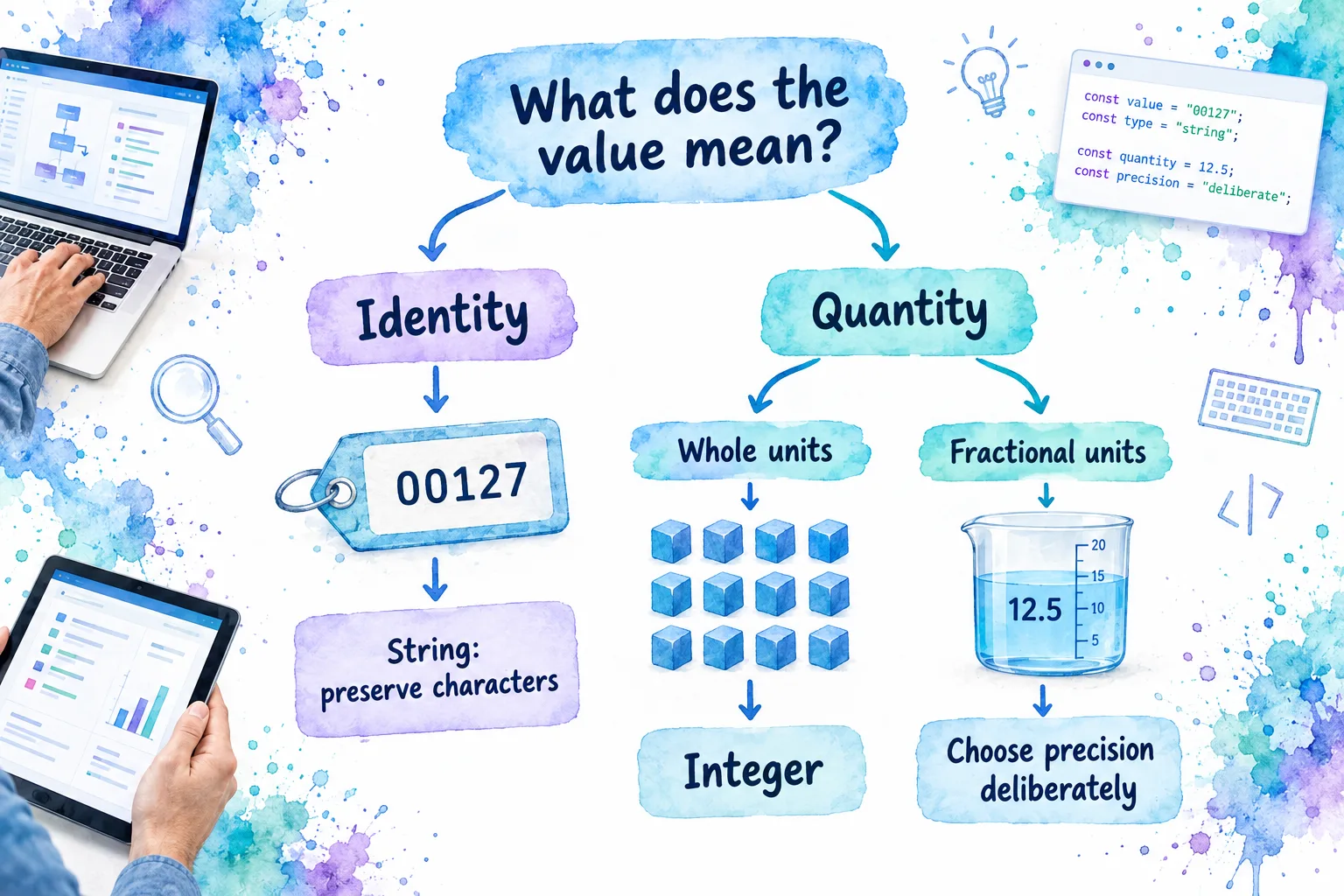
For application development, we separate three questions:
- Meaning: Is this a quantity, an identifier, or a coded category?
- Type: Is it stored as an integer, a floating-point number, an exact decimal, or text?
- Representation: How does it appear in a payload or on screen?
These questions need not produce the same label. An exact amount may travel as text, while a digit-only customer code should not become a quantity.
“Numeric” also names a company. This guide addresses the general data meaning, not that company’s products. We focus on data modeling rather than implementing Vue input controls.
Numeric values and numeric-looking strings: quick examples
In JSON, quotation marks distinguish strings from numbers. The values 12 and "12" therefore have different types, even when they look similar on screen. See JSON’s format reference.
| Example | Meaning | Sensible application representation | Reason |
|---|---|---|---|
12 items |
Count | Integer | Fractions do not describe individual items in this example. |
-4.5 degrees |
Measurement | Numeric value with a declared unit | The sign and fractional part carry meaning. |
"00127" |
Account code | String | Every character, including initial zeroes, identifies the account. |
"02108" |
Postal code | String | It identifies a location rather than measuring one. |
"19.90" with USD |
Exact amount | Decimal string under an explicit API contract | Text can preserve decimal digits for a decimal-aware consumer. |
"003" |
Could be a code or a written count | Decide from the domain | Characters alone do not establish meaning. |
The table gives modeling recommendations, not universal database requirements. In particular, calling an amount a string describes its transport representation, not whether it has numerical meaning.
Why digit-only identifiers should usually stay text
A useful first question is: Would arithmetic on this value represent something meaningful? Adding two item counts gives a total. Adding two account codes does not identify a useful combined account.
Leading zeroes make the difference visible. If the account code is "00127", reducing it to the numerical value 127 loses information. Padding it later is safe only if an authoritative format already specifies the original width. Otherwise, the application cannot know whether the source was 127, 0127, or 00127.
JSON reinforces this distinction: its number grammar does not allow an integer such as 00127, whereas a quoted string can preserve those characters. RFC 8259, section 6 defines that grammar.
We recommend treating identity separately from magnitude:
- An account code needs stable character preservation and identity comparisons.
- A quantity needs numerical comparisons and possibly arithmetic.
- A coded category needs its category definition, even if the code happens to be
1,2, or3.
The arithmetic question is a heuristic, not a ban on integer identifiers. An existing system may legitimately assign integer database keys. Respect that contract, but do not convert a public identifier merely because every character is a digit.
Integers, decimal values, and floating-point numbers
These terms answer different questions. Integer describes a whole-number value. Decimal notation describes a way of writing a number. Floating point describes a representation used for computation.
| Term | Practical meaning | Example |
|---|---|---|
| Integer | A number with no fractional component | 0, 12, -7 |
| Fractional value | A number with a nonzero fractional component | 1.25, -4.5 |
| Exact decimal type | A representation designed to preserve decimal values within defined limits | A database decimal amount |
| Binary floating point | A representation that approximates some decimal fractions | JavaScript’s ordinary Number type |
PostgreSQL 18 documents whole-number integer types and exact versus inexact numeric types. JavaScript’s representation is specified separately in ECMAScript 2025’s Number type.
Do not infer a universal runtime type from the word “numeric.” JavaScript has both Number and BigInt; a database may distinguish several integer sizes, exact decimals, and floating-point types. A field definition needs a concrete representation, not just the instruction “accept numeric data.”
Precision, scale, and leading zeroes are different concerns
For a conventional decimal definition, precision describes the total significant digit capacity, while scale describes digits to the right of the decimal point. PostgreSQL uses 23.5141 as an example with precision 6 and scale 4. Its documentation also explains that a column with a declared scale can round incoming values to that scale. See PostgreSQL’s arbitrary-precision numeric documentation.
Three concerns deserve separate decisions:
Exactness: Must the stored value preserve a decimal amount exactly, or is a controlled approximation acceptable?
Permitted detail: How many fractional digits does the domain accept? A measurement and an amount need not share a scale.
Presentation: Should the interface show 19.9, 19.90, or a currency-formatted label? Equal mathematical values can have different display requirements.
Leading zeroes in an identifier are not decimal precision. They are part of its character sequence. Likewise, displaying two decimal places does not establish how arithmetic was performed.
For exact-amount workflows, we recommend specifying the decimal representation and rounding rule together. A decimal type still has limits, and an exact storage choice does not eliminate deliberate rounding when a calculation produces more detail than the contract permits.
JavaScript numbers and large values
JavaScript’s ordinary Number uses IEEE 754 binary64. It represents both whole and fractional values, but it cannot represent every possible integer or decimal fraction exactly. This is a property of the representation, not a Vue component defect. The ECMAScript 2025 specification defines the type.
For JSON exchanged with binary64-based consumers, RFC 8259 identifies the inclusive integer range -9,007,199,254,740,991 through 9,007,199,254,740,991 as exactly interoperable. Some larger integers are representable, but consecutive integers beyond that range are not all distinguishable. RFC 8259 explains the interoperability boundary.
Consequently, we would not casually convert a long account reference to a JavaScript number. An identifier should preserve its characters; a genuinely large numerical quantity needs a representation supported throughout its processing path.
For a visual explanation of floating-point representation, this independent Computerphile video is a useful companion:
How JSON representation affects numeric data
Serialization turns application data into a transferable representation. It does not automatically preserve every distinction your domain cares about. JSON supports numbers and strings as separate value types, as shown in the JSON format reference.
Consider this illustrative payload:
{
  "accountCode": "00127",
  "itemCount": 12,
  "unitPrice": "19.90",
  "currency": "USD"
}
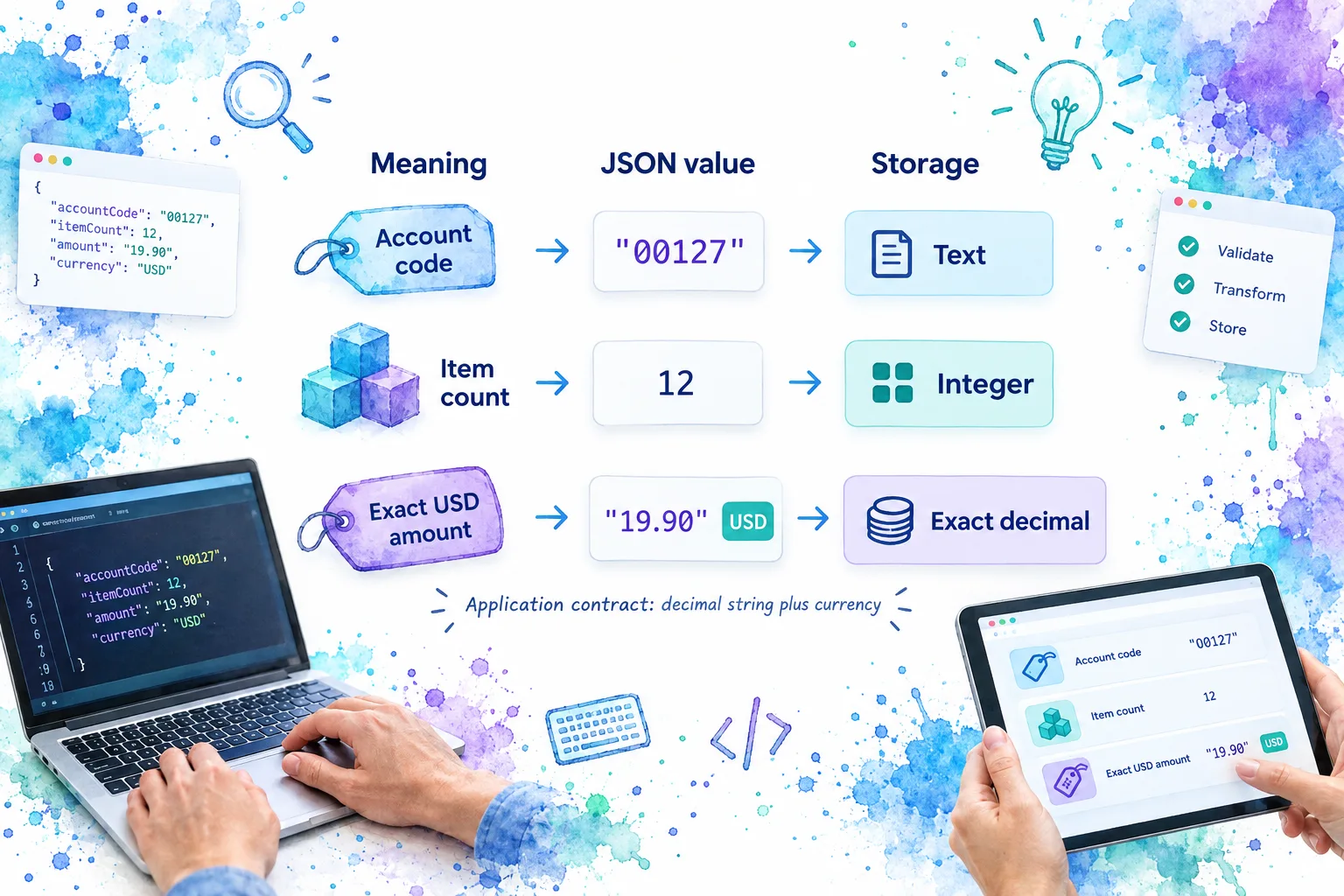
Here we deliberately choose three contracts:
accountCodeis text because its character sequence carries identity.itemCountis a number because it represents a count.unitPriceis a decimal string because this example’s API delegates exact decimal interpretation to a decimal-aware consumer.
The third choice is an application convention, not a special JSON decimal type. The consumer must know that the string represents an amount and apply the agreed currency, scale, and rounding rules. Quoting a value preserves text; it does not make arithmetic happen automatically.
An exact amount might instead use integer minor units under a different contract. If you choose that approach, document the currency and unit explicitly rather than assuming every currency or workflow uses two decimal places.
Review the complete path: source system, API payload, application state, persistence, and export. Our recommendation is to check each conversion boundary. Preserving decimal text during transport does not help if an earlier stage has already reduced the value to an unwanted approximation.
A compact numeric data contract
Before building the interface, write down the answers below. We find this more useful than starting with a field labeled “Number.”
| Decision | Example answer |
|---|---|
| What does the value mean? | Count of individual items |
| What is one unit? | One item, not one case |
| Are fractions meaningful? | No |
| What must remain exact? | The whole count within the supported range |
| How does it travel? | JSON number |
| What does missing mean? | Unknown, distinct from a confirmed zero |
| Where is it stored? | An integer column with an appropriate supported range |
For an account code, the answers change: the value is an identifier, leading zeroes matter, and text is the intended representation. For a measured duration, fractional hours may be meaningful, and the acceptable precision needs a domain decision.
For a Vue application, we recommend settling that contract before choosing a control. This article stops at the representation boundary; the implementation, editing, and validation details belong in the focused guides under Recommended Reads.
Frequently asked questions
Is 1.0 an integer or a decimal?
Mathematically it is an integer value written with a decimal point. JSON Schema considers both 1 and 1.0 integers because both have a zero fractional part. A visible decimal point alone does not determine the schema classification. See JSON Schema’s numeric type reference.
Does a numeric schema accept "42"?
Not simply because it contains digits. JSON Schema’s number and integer types reject "42" because it is a string. Any application-level coercion is a separate policy, not a consequence of those types. JSON Schema documents both cases.
Should a blank numeric value become zero?
Not by default. We recommend distinguishing “no answer” from a confirmed zero and documenting how missing data travels. For example, an unanswered stock count and a completed count of zero describe different operational states.
Put the data meaning first
Choose one field and document its meaning, exactness requirements, and transport representation. Once you know it is an editable quantity, explore our Number Input documentation and playground as a next step toward the interface.
Sources
- Cambridge Dictionary: Numeric
- Numeric: Official website
- JSON: Introducing JSON
- IETF RFC 8259: The JSON Data Interchange Format
- ECMAScript 2025: Data Types and Values
- PostgreSQL 18: Numeric Types
- JSON Schema: Numeric Types
- Computerphile: Floating Point Numbers